


4.3 Spacetime, Minkowski Diagrams, and Four-Vectors#
Notebook overview#
§4.2 derived the Lorentz transformation and its consequences as algebra. This notebook reveals the geometry hiding underneath. Minkowski’s insight, a few years after Einstein, was that space and time are not separate stages but a single four-dimensional spacetime, and that the Lorentz transformation is simply a rotation of that spacetime, of an unusual hyperbolic kind. Once we see it this way, time dilation, length contraction, and the relativity of simultaneity stop being separate effects to memorise: they are projections onto tilted axes, read straight off a diagram.
We build that diagram, the Minkowski diagram, as a reusable drawing primitive, and use it throughout: worldlines as paths through spacetime, the light cone as the absolute boundary between cause and coincidence, the boosted axes closing symmetrically toward the light line, and the invariant hyperbolae along which a boost slides events. One animation sets the whole picture in motion, sweeping the boost speed and watching the geometry rotate.
The notebook also builds the computational toolkit for the rest of the volume. A
four-vector is just a numpy array of four numbers that transform together, and its
invariant length is a contraction with the Minkowski metric \(\eta=\operatorname{diag}
(-1,1,1,1)\). We develop the Einstein summation convention made literal by np.einsum,
explaining the index-string grammar carefully and verifying it against an explicit
nested sum, because the reader must be able to trust an index string before relying on
it. These tools, the metric, np.einsum, the \(4\times4\) boost, recur in §4.7 (relativistic
dynamics), §4.8 (the curved-spacetime capstone), and were already used in §3.12.
Everything is in SI units, with \(c=1/\sqrt{\mu_0\varepsilon_0}=2.998\times10^8\,\)m/s; spacetime components \((ct,x,y,z)\) are all lengths in metres, so the axes share units. One effect here is genuinely dynamic, a boost rotating the whole diagram, and is animated; the rest are clean stills.
How to read the checks. Each exercise closes with a
validatecall against an independent fact: the worldline slopes; \(\cosh\varphi=\gamma\) and \(\sinh\varphi=\gamma \beta\); the interval fixed under a boost; the norm agreeing acrossnp.einsum,@, and an explicit loop; the causal classification frame-independent; the four-vector norm boost-invariant; the inertial worldline having the longest proper time. A ✓ is strong evidence; a ✗ is a prompt to locate the discrepancy, not a verdict.Scope. The geometry of spacetime and the four-vector toolkit; the paradoxes follow in §4.4 and relativistic dynamics in §4.5–§4.7. See Minkowski’s 1908 “Space and Time”; Taylor & Wheeler, Spacetime Physics [TW92]; Nolting, Theoretical Physics 4 [Nol17]; and §4.2 (rapidity) and §3.12 (four-vectors and the field tensor as used).
Theory in brief#
Spacetime and the interval as geometry#
An event is a point in spacetime, labelled \((ct,x,y,z)\). The invariant interval of §4.2 plays the role of a squared distance, but with a crucial sign,
The Minkowski metric \(\eta\) carries the minus sign that makes time different from space. Unlike a Euclidean distance, \(s^2\) can be negative, zero, or positive, and that sign is physics.
The boost as a hyperbolic rotation#
In the rapidity \(\varphi=\operatorname{arctanh}(v/c)\) of §4.2, the boost on \((ct,x)\) is
This is to the interval exactly what an ordinary rotation \(\begin{psmallmatrix}\cos & -\sin \\ \sin & \cos\end{psmallmatrix}\) is to Euclidean distance: a hyperbolic rotation that preserves \(-(ct)^2+x^2\) and slides events along hyperbolae instead of circles.
The light cone and causal structure#
The null surface \(ct=\pm|x|\) is the light cone. The sign of \(s^2\) classifies any pair of events absolutely,
Because \(s^2\) is invariant, every observer agrees on this classification: the causal structure of spacetime is frame-independent.
Minkowski diagrams#
Plot \(ct\) vertically against \(x\) horizontally. A stationary object is a vertical worldline, a moving one is tilted, light is at \(45^\circ\). A boost to \(v=\beta c\) tilts the primed axes symmetrically toward the light line,
with slope product \(1\). Time dilation and length contraction are projections onto these tilted axes, and the \(x'\)-axis is precisely the set of events \(S'\) calls simultaneous, so the relativity of simultaneity becomes visible.
Four-vectors#
The position four-vector \(x^\mu=(ct,x,y,z)\) transforms by the Lorentz matrix, and its norm \(\eta_{\mu\nu}x^\mu x^\nu\) is the invariant interval,
Any four quantities that transform this way form a four-vector (four-velocity and four-momentum follow in §4.5). The payoff: write a law as a four-vector equation and it holds, unchanged, in every inertial frame.
Computational tools for four-vectors#
We make this literal. A four-vector is a numpy 4-array; the metric \(\eta\) is an explicit
array; the Einstein summation convention (repeated index summed, free index kept) is
np.einsum with an index string,
A repeated letter is summed, the letters after -> are kept, so an empty right side is a
scalar. Use @ for plain matrix-vector products (\(\Lambda x\)) and np.einsum for the
general index gymnastics. Exercise 4 verifies the index string against an explicit nested
loop, because trusting the notation is the whole point.
Setup#
Data and instruments only: the series palette, the Minkowski metric
\(\eta=\operatorname{diag}(-1,1,1,1)\) that fixes this notebook’s signature, and the
Lorentz factor \(\gamma(\beta)\) of §4.2, which enters
here as the known quantity the geometry is checked against. The notebook’s own
toolkit is not here: you write the \(2\times2\) hyperbolic rotation boost2 in
Exercise 2, the Minkowski norm four_norm in Exercise 4, and the \(4\times4\) boost
boost4 in Exercise 5. Every change of frame, every interval, and every causal
classification from there on runs on those three. The only randomness in the notebook
is the arbitrary four-vector of Exercise 9, seeded there.
The Setup below holds this notebook’s data and instruments — nothing you are asked to build. It is collapsed so the building stays yours; expand it whenever you want the details.
Exercise 1 — The Minkowski diagram and worldlines (worked)#
A Minkowski diagram plots \(ct\) upward against \(x\) rightward, so that the path of an
object through spacetime, its worldline, is a curve on the page. A stationary object
stays at fixed \(x\), a vertical line; an object at \(v=\beta c\) traces \(x=\beta\,ct\), a line
of slope \(1/\beta\) in \(ct\)-vs-\(x\), steeper than \(45^\circ\) because \(\beta<1\); and light
moves at \(45^\circ\), the light cone (Fig. 355). We build the
reusable ecp.draw spacetime-diagram primitive here and use it for the rest of the
volume.
Part a) Draw the diagram on the ruled grid with draw.spacetime_diagram, and add
three worldlines with draw.worldline: a stationary object, one moving at \(v=0.5c\),
and a light ray.
Part b) Confirm the slopes numerically, as plain numpy ratios: the light
worldline at \(45^\circ\) (slope \(1\) in \(ct\)-vs-\(x\)) and the massive one at slope
\(1/\beta=2\), steeper, so that it stays inside the cone.
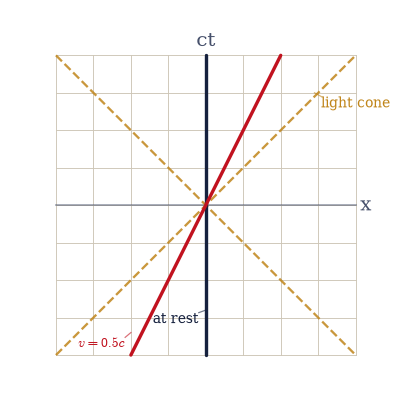
Fig. 355 The Minkowski diagram. Time runs up (\(ct\)), space across (\(x\)). A stationary object has a vertical worldline (dark); an object at \(v=0.5c\) tilts to slope \(1/\beta=2\) (red), always steeper than the \(45^\circ\) light line; light itself rides the light cone \(ct=\pm x\) (amber dashed). Everything a massive object can do lives inside that cone.#
light worldline slope (ct vs x) = 1.000  (45°)
v=0.5c worldline slope          = 2.000  (steeper, inside the cone)
Validation 1#
✓  the light worldline sits at 45° (slope 1 in ct vs x)   [got 1 vs expected 1 (rtol=1e-12, atol=1e-09)]
✓  a massive worldline is steeper than the light line — it stays inside the cone
True
Exercise 2 — The boost as a hyperbolic rotation (worked)#
Here is the central geometric fact. In the rapidity \(\varphi=\operatorname{arctanh} (\beta)\) of §4.2, the Lorentz boost Eq. 342 is built from \(\cosh \varphi\) and \(\sinh\varphi\) exactly as an ordinary rotation is built from \(\cos\) and \(\sin\), with \(\cosh\varphi=\gamma\) and \(\sinh\varphi=\gamma\beta\). A boost is therefore a hyperbolic rotation of the spacetime plane: as the speed grows, the primed axes close symmetrically toward the \(45^\circ\) light line, and a fixed event’s coordinates slide along an invariant hyperbola (Fig. 356).
The matrix built below is checked against the \(\gamma\)-form of §4.2, \(\Lambda=\begin{psmallmatrix}\gamma & -\gamma\beta\\ -\gamma\beta & \gamma\end{psmallmatrix}\), which is the same boost written in the variable \(\beta\) instead of \(\varphi\); the two agreeing entry by entry is exactly the statement \(\cosh\varphi=\gamma\), \(\sinh\varphi=\gamma\beta\). The worked speed is \(\beta=0.6\).
Part a) Write boost2(beta), returning the \(2\times2\) boost \(\Lambda(\varphi)\) of
Eq. 342 acting on the column \((ct,x)\): form the rapidity
\(\varphi=\operatorname{arctanh}\beta\) with np.arctanh, then assemble the explicit
array \(\begin{psmallmatrix}\cosh\varphi & -\sinh\varphi\\ -\sinh\varphi &
\cosh\varphi\end{psmallmatrix}\) with np.cosh and np.sinh. Write this one
yourself — the implementation is the lesson, and every change of frame in this
notebook goes through it.
Part b) Confirm \(\cosh\varphi=\gamma\) and \(\sinh\varphi=\gamma\beta\) at
\(\beta=0.6\), and check with np.allclose that your matrix equals the \(\gamma\)-form
boost entry for entry.
Part c) Set the picture in motion: sweep \(\beta\) from \(0\) to \(0.9\), closing the primed axes toward the light line while a fixed event rides its invariant hyperbola.
β = 0.6:  φ = arctanh(β) = 0.693147
cosh φ = 1.250000   γ    = 1.250000
sinh φ = 0.750000   γβ   = 0.750000
rapidity-form boost equals the standard γ-form: True
Validation 2#
✓  the boost is a hyperbolic rotation: cosh φ = γ, sinh φ = γβ   [max|Δ| = 0 (rtol=1e-09, atol=1e-09)]
✓  the rapidity-form and γ-form boosts are the same matrix
True
Fig. 356 A boost is a hyperbolic rotation (animated). As the speed sweeps \(\beta=0\to0.9\), the primed axes (amber) close symmetrically toward the \(45^\circ\) light line, never crossing it, and a fixed event (red) slides along its invariant hyperbola (dotted) rather than along a circle. This is the geometric meaning of the rapidity result of §4.2: the boost rotates spacetime hyperbolically, leaving the interval \(-(ct)^2+x^2\) fixed.#
Exercise 3 — Invariant hyperbolae and the geometry of dilation and contraction (worked)#
Where an ordinary rotation moves points along circles of fixed radius, a boost moves events along the invariant hyperbolae \(-(ct)^2+x^2=\text{const}\) Eq. 341. These curves are the level sets of the interval, and a boost cannot leave one. Reading time dilation and length contraction off the diagram is now a matter of projecting onto the tilted axes: a unit tick of the moving clock reaches higher up our \(ct\)-axis than its own, and a moving rod projects shorter onto our \(x\)-axis (Fig. 357).
Part a) Take the event \((ct,x)=(1.2,0.4)\,\)m, boost it to \(0.5c\) with the boost2
you wrote in Exercise 2, and confirm with the explicit combination \(-(ct)^2+x^2\) that
its interval is unchanged: the boost has slid it along one hyperbola and cannot take it
off.
Part b) Draw the timelike and spacelike hyperbolae \(-(ct)^2+x^2=\mp1\) together with the boosted axes and the event’s two positions, so the algebra of Part a) becomes a picture.
event (ct, x) = (1.200, 0.400) m   →   s² = -1.2800 m²
after a 0.5c boost = (1.155, -0.231) m   →   s² = -1.2800 m²
the event moved, but its interval (its hyperbola) did not
Validation 3#
✓ boosts slide events along invariant hyperbolae (s² fixed) [got -1.28 vs expected -1.28 (rtol=1e-09, atol=1e-09)]
True
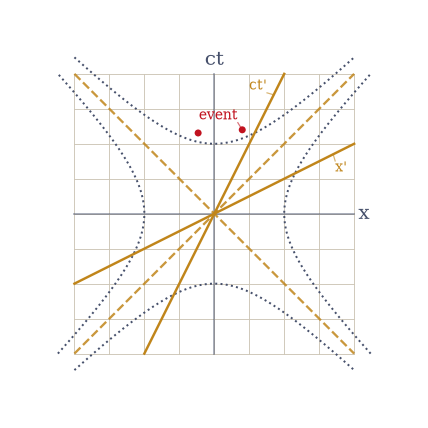
Fig. 357 Invariant hyperbolae and the geometry of a boost. The dotted curves are level sets of the interval, \(-(ct)^2+x^2=\pm1\); a boost to \(v=0.5c\) tilts the primed axes (amber) toward the light line and slides the event (red) from its rest position along the timelike hyperbola, never off it. Time dilation and length contraction are simply this event’s projections onto the unprimed versus primed axes.#
Exercise 4 — The four-vector toolkit: np.einsum and the metric (worked)#
Now we build the computational language of the rest of the volume, in the careful,
tools-with-a-note style of §3.5. A four-vector is a numpy array of four numbers; the
metric \(\eta=\operatorname{diag}(-1,1,1,1)\) is an explicit array; and the inner product
\(\eta_{\mu\nu}x^\mu x^\nu\) is a sum over repeated indices, which np.einsum writes
literally. The index string is the grammar: each letter is an index, a letter
repeated on the input side is summed over, and the letters after -> are kept, so
'a,ab,b->' (empty right side) contracts everything to a scalar
Eq. 346. Raising or lowering an index, \(x_\mu=\eta_{\mu\nu}x^\nu\), is
'ab,b->a', which keeps one free index and flips the sign of the time component.
The four-vector used below is \(x^\mu=(1.3,0.5,0.2,0)\,\)m, timelike, so its norm should come out negative.
Part a) Write four_norm(x), returning the Minkowski norm \(\eta_{\mu\nu}x^\mu
x^\nu\) Eq. 346 of a length-4 array as the single contraction
np.einsum('a,ab,b->', x, ETA, x) — the summation convention made literal, negative
for timelike, zero for null, positive for spacelike four-vectors. It is the workhorse
of every exercise that follows.
Part b) Earn the right to trust that index string: compute the same norm two more
ways, as the chained matrix product x @ ETA @ x and as an explicit double
for-loop over \(\mu\) and \(\nu\), and confirm with np.allclose that all three agree.
An index string is worth using only once it has matched the loop it abbreviates.
Part c) Lower the index with np.einsum('ab,b->a', ETA, x) and watch the time
component change sign, the metric’s minus sign doing its one job.
η_μν x^μ x^ν  via np.einsum = -1.400000
              via @ @       = -1.400000
              via for-loops = -1.400000
all three agree: True

x^μ (upper) = [1.3 0.5 0.2 0. ]
x_μ (lower) = [-1.3  0.5  0.2  0. ]   (the time component flipped sign)
Validation 4#
✓  the four-vector norm via np.einsum, @, and an explicit sum all agree   [max|Δ| = 0 (rtol=1e-12, atol=1e-09)]
✓  lowering the index flips the sign of the time component   [got -1.3 vs expected -1.3 (rtol=1e-12, atol=1e-09)]
True
Exercise 5 — The causal structure of spacetime (worked)#
The sign of the interval is not a convention but the deepest invariant in physics. Two events separated by a timelike interval (\(s^2<0\)) can be connected by something slower than light, so one can cause the other; a spacelike separation (\(s^2>0\)) lies outside the light cone, so no signal can pass and neither event can influence the other; a null separation (\(s^2=0\)) is exactly a light ray Eq. 343. Because \(s^2\) is invariant, this classification is the same in every frame: the causal order of spacetime is absolute even though time and space separately are not (Fig. 358).
Testing that claim needs a boost that acts on all four components, not just the \((ct,x)\) pair of Exercise 2. The \(2\times2\) hyperbolic rotation extends to one in the obvious way: a boost along \(x\) does nothing at all to \(y\) and \(z\), so it sits as a block in the corner of a \(4\times4\) matrix whose transverse part is the identity.
Part a) Write boost4(beta), that \(4\times4\) Lorentz boost along \(x\)
Eq. 345: \(\gamma\) in the \((0,0)\) and \((1,1)\) slots, \(-\gamma\beta\) in
the \((0,1)\) and \((1,0)\) slots — the Exercise 2 block, now in \(\gamma\)-form using the
Setup’s gamma — and \(1\) on the remaining diagonal, \(0\) everywhere else. Write this
one yourself — the implementation is the lesson, and every four-vector in the rest of
the notebook changes frame through it.
Part b) Take three events, one per causal class: \((2,0.5,0,0)\) inside the cone,
\((0.5,2,0,0)\) outside it, and \((1.5,1.5,0,0)\) exactly on it. Classify each separation
from the origin by the sign of \(s^2\), computed as the four_norm you wrote in
Exercise 4 applied to the difference four-vector, then boost both endpoints to a frame
at \(0.7c\) and confirm the sign — and so the causal class — is unchanged.
separation    s² (rest)    s² (0.7c frame)    class preserved
  timelike   -3.7500      -3.7500          True
  spacelike   3.7500       3.7500          True
  null        0.0000       0.0000          True
Validation 5#
✓ the timelike/spacelike/null classification is frame-independent (causal structure is absolute)
True
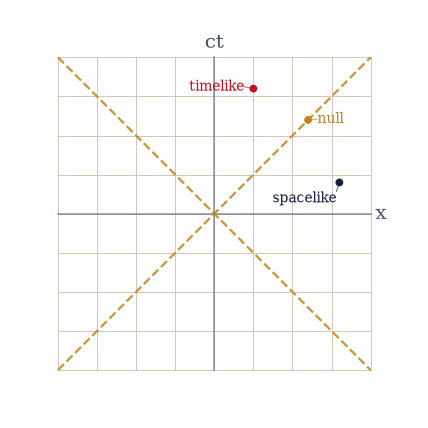
Fig. 358 The causal structure. The light cone (amber) splits spacetime into regions an observer at the origin can and cannot reach. Events inside the cone are timelike-separated (red, causally connectable, in the absolute past or future); events outside are spacelike (dark, no causal link, the absolute elsewhere); events on the cone are null (a light signal). The sign of \(s^2\) assigns each event to its region, and no boost can move an event across the cone.#
Exercise 6 — The four-vector norm is boost-invariant (student)#
The whole reason four-vectors matter is that their norm is a Lorentz scalar: apply any boost and \(\eta_{\mu\nu}x^\mu x^\nu\) comes out the same Eq. 345. This is why writing a physical law as a four-vector equation makes it automatically frame- independent, the strategy that drives all of relativistic mechanics and the covariant Maxwell equations of §3.12.
Part a) Apply the boost4 you wrote in Exercise 5, at \(\beta=0.8\), to the
four-vector \(x^\mu=(2,1,0.5,0.3)\,\)m using the matrix product @, and confirm with
your Exercise 4 four_norm that the norm before and after the boost agree — even
though every one of the first two components has changed.
four-vector       = [2.  1.  0.5 0.3]
after a 0.8c boost = [ 2.  -1.   0.5  0.3]
norm before = -2.660000 m²,  norm after = -2.660000 m²
Validation 6#
✓ the four-vector norm is invariant under a Lorentz boost [got -2.66 vs expected -2.66 (rtol=1e-10, atol=1e-09)]
True
Exercise 7 — Reading a paradox off the diagram (student)#
The Minkowski diagram dissolves the twin paradox before we even compute. One twin stays home (a straight, vertical worldline); the other flies out at \(v=\beta c\) and returns (a bent worldline). The proper time each twin ages is the “length” of their worldline in the spacetime metric, \(c\,\tau=\int\sqrt{(c\,dt)^2-dx^2}\), and because of the minus sign this bent path is shorter than the straight one, the opposite of the Euclidean rule that a straight line is the shortest distance (Fig. 359). The travelling twin returns younger. We meet the full resolution in §4.4; here we read it off the geometry.
The two proper times are known in closed form and need no integration: the stay-home twin is inertial, so their proper time is just the coordinate time \(T\), while each of the traveller’s two legs runs at constant speed and is dilated by the same \(\gamma\), so the traveller ages \(T/\gamma\). The round trip below has \(T=2\) (in units of \(ct\)) at \(\beta=0.6\).
Part a) Draw the two worldlines with the spacetime-diagram primitive: the stay-home twin’s straight vertical line, and the traveller’s outbound and inbound legs meeting at the turnaround.
Part b) Put numbers on the picture. Compute both proper times and confirm, as an
explicit numpy comparison, that the bent worldline is the one that ages less.
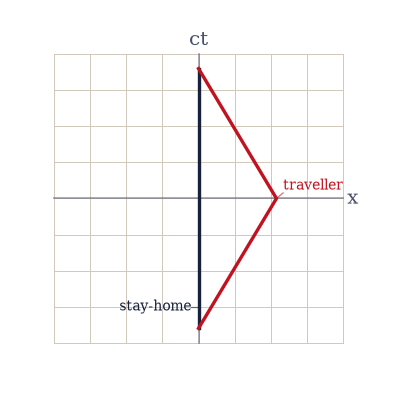
Fig. 359 The twin paradox as geometry. The stay-home twin follows the straight vertical worldline (dark); the travelling twin’s worldline (red) bends out at \(v=0.6c\) and back. In the spacetime metric the bent path is shorter in proper time than the straight one — the reverse of Euclidean intuition — so the traveller returns younger. The asymmetry is real and visible: only the traveller’s worldline is bent (changes frame).#
round trip at β = 0.6:  γ = 1.250
stay-home twin ages  τ = 2.0000
travelling twin ages τ = 1.6000   (younger by a factor γ)
Validation 7#
✓ the inertial (straight) worldline has the longest proper time — the traveller ages less
True
Exercise 8 — Velocity as a slope; the speed limit, geometrically (student)#
The light cone is the cosmic speed limit drawn as geometry. A massive particle’s worldline must be timelike everywhere, steeper than \(45^\circ\) in \(ct\)-vs-\(x\), which is the same as saying its speed \(\beta<1\); light rides exactly on the cone at \(45^\circ\); and nothing has a spacelike worldline, because that would mean \(\beta>1\) and an interval that some frame sees running backward in time. The speed limit is not a law imposed on top of spacetime, it is the shape of spacetime.
A worldline’s causal character is read off any step along it, and the convenient step for speed \(\beta\) is the four-vector \((1,\beta,0,0)\): advance \(ct\) by one unit and \(x\) by \(\beta\).
Part a) For the candidate speeds \(\beta=0.2,\,0.5,\,0.9,\,1\), classify each
worldline by the sign of the interval of that step, computed with your Exercise 4
four_norm, and confirm with a numpy comparison that every massive worldline
(\(\beta<1\)) comes out timelike — inside the cone — while \(\beta=1\) comes out null, on
it.
   β      interval sign of a worldline step      class
  0.2            -0.9600                    timelike
  0.5            -0.7500                    timelike
  0.9            -0.1900                    timelike
  1.0             0.0000                    null (light)
Validation 8#
✓ massive particles travel slower than light — their worldlines lie inside the cone
True
Exercise 9 — Geometry is the deeper language#
Step back and see what the geometry bought us. Everything in §4.2, the transformation, time dilation, length contraction, velocity addition, was the shadow of a single structure: spacetime carries an indefinite metric \(\eta=\operatorname{diag}(-1,1,1,1)\), and Lorentz boosts are its rotations, hyperbolic rather than circular. The light cone is the absolute causal framework, the invariant hyperbolae are the orbits of a boost, and four-vectors are the natural objects: any law written as a four-vector equation is relativistically invariant by construction. This is the language in which §3.12 wrote the field tensor and in which all of relativistic dynamics is cast.
One fact underlies all the rest, and it deserves the last word. Everything so far used four-vectors we chose; the invariance holds for four-vectors nobody chose.
Part a) Draw an arbitrary four-vector from a seeded generator and confirm in a
single check that your Exercise 5 boost4, at \(\beta=0.55\), leaves its four_norm
unchanged to machine precision — the invariance that makes geometry, not algebra, the
true home of relativity.
random four-vector: [ 0.457 -1.369 -1.44   1.018]
norm preserved under a 0.55c boost: True
space and time are shadows; spacetime, with its metric, is the substance
Validation 9#
✓ a boost preserves the Minkowski norm — four-vector equations are automatically invariant
True
Notebook summary#
The Minkowski diagram Eq. 344: \(ct\) versus \(x\), worldlines as paths; light at \(45^\circ\), massive objects steeper (slope \(1/\beta>1\)), built as the reusable
draw.spacetime_diagramprimitive (withworldline,boosted_axes,hyperbola), reused in §4.4 and the GR capstone.The boost as a hyperbolic rotation Eq. 342: \(\Lambda\) is \(\cosh\varphi,\sinh\varphi\) with \(\cosh\varphi=\gamma\), \(\sinh\varphi=\gamma\beta\); the primed axes close symmetrically toward the light line and events slide along the invariant hyperbolae \(-(ct)^2+x^2=\) const, the interval fixed under the boost.
The four-vector toolkit Eq. 346: four-vectors as
numpy4-arrays, the metric \(\eta=\operatorname{diag}(-1,1,1,1)\) explicit, and the norm \(\eta_{\mu\nu} x^\mu x^\nu\) asnp.einsum('a,ab,b->', x, ETA, x), verified equal tox @ ETA @ xand an explicit loop (\(-1.40\,\)m²); lowering an index'ab,b->a'flips the time sign.Causal structure Eq. 343: the sign of \(s^2\) sorts every pair into timelike / null / spacelike, and a \(0.7c\) boost leaves the class unchanged, the absolute causal order of spacetime.
Invariance and consequences Eq. 345: the four-vector norm is boost- invariant (\(0.8c\), to \(10^{-10}\)); the inertial twin’s straight worldline has the longest proper time (the traveller ages by \(T/\gamma\)); and massive worldlines lie strictly inside the light cone, the speed limit as geometry.
Outlook#
The paradoxes, resolved by computation (§4.4). The twin and pole-and-barn, settled by proper-time integrals along the worldlines drawn here.
Four-velocity and four-momentum; \(E=mc^2\) (§4.5). The next four-vectors, with the metric and
np.einsumtoolkit of Exercise 4 carried straight over.Relativistic dynamics and fields (§4.7). Where four-vectors meet forces, reusing the tensor machinery; the field tensor \(F^{\mu\nu}\) of §3.12 lives in exactly this geometry.
The curved-spacetime capstone (§4.8). The same metric, now position-dependent, with
np.einsumcontractions over a curved \(\eta\to g_{\mu\nu}\).The Lorentz group as the symmetry group of spacetime, rotations and boosts together (a pointer).