


4.4 The Paradoxes, Computed#
Notebook overview#
Special relativity has a reputation for paradox: twins who age differently, a pole that fits in a barn too short to hold it, clocks that each run slow in the other’s frame. This notebook takes the three most famous of these and shows that none is a contradiction. Each is a clash between Newtonian intuition and the correct relativistic account, and each dissolves the moment we stop arguing in words and instead compute — either the proper time along the actual worldlines, or the consequences of taking the relativity of simultaneity seriously. There is no new physics here, only the careful application of §4.1–§4.3.
Two tools do all the work. The first is the proper time \(\tau=\int\sqrt{1-\beta(t)^2} \,dt\), the time a clock actually reads as it travels its worldline, which we met geometrically in §4.3 and now evaluate as a genuine integral. Its central, counter-Euclidean property is that the inertial (straight) worldline between two events has the longest proper time, so the twin who accelerates ages less. The second tool is the relativity of simultaneity of §4.1: “the pole is fully inside with both doors shut at once” is a statement about simultaneity, and simultaneity is frame-dependent, so the two frames simply disagree about it without contradicting each other.
We compute the twin paradox twice, once with an idealized instant turnaround and once with an honest smoothly-accelerated profile integrated two independent ways, and animate the two clocks drifting apart. We resolve the pole and barn in both frames and read the resolution off a Minkowski diagram. We close with the relativistic Doppler effect, including the purely relativistic transverse shift that has no classical analog and is a clean experimental test of time dilation.
Times are quoted in years or nanoseconds as stated; \(\beta=v/c\) is dimensionless, with
\(c=1/\sqrt{\mu_0\varepsilon_0}=2.998\times10^8\,\)m/s where a length enters. The still worldline
figures use the ecp.draw spacetime-diagram primitive built in §4.3. One effect, the twins’
clocks developing in time, is genuine motion and is animated; the rest are clean stills.
How to read the checks. Each exercise closes with a
validatecall against an independent fact: the travelling twin’s \(T/\gamma\); the proper-time integral agreeing acrossnp.trapezoidandscipy.integrate.quad; the inertial worldline being the longest; each frame seeing the other object contracted; the door-closings offset by \(\gamma vL/c^2\); the Doppler shifts. A ✓ is strong evidence; a ✗ is a prompt to locate the discrepancy, not a verdict.Scope. The kinematic paradoxes and the Doppler effect; relativistic dynamics (four-momentum, \(E=mc^2\)) is §4.5. See Taylor & Wheeler, Spacetime Physics [TW92]; Nolting, Theoretical Physics 4 [Nol17]; and §4.1 (simultaneity), §4.2 (the transformation), §4.3 (proper time and the diagram primitive).
Theory in brief#
Why “paradoxes” are not contradictions#
Every special-relativity paradox is a clash between Newtonian intuition and the correct relativistic account, and every one resolves with a tool already in hand,
We settle each by computation, not rhetoric.
Proper time along a worldline#
The time a clock reads is the proper time, the “length” of its worldline in the spacetime metric,
Because of the minus sign in the metric, the inertial (straight) worldline between two events has the maximum proper time, the exact reverse of the Euclidean rule that a straight line is the shortest path. This single fact resolves the twin paradox.
The twin paradox#
One twin travels out and back at high speed while the other stays home,
The apparent symmetry — “each sees the other’s clock run slow” — is false, because the worldlines are not symmetric: the traveller accelerates to turn around, and the stay-home twin does not. Integrating proper time along each worldline settles it with no ambiguity. We do both the idealized instant turnaround and an honest smooth acceleration.
The pole-barn (ladder) paradox#
A pole of proper length \(L_p\) longer than a barn of proper length \(L_b\) “fits” inside when it runs through fast, length-contracted, in the barn frame; but in the pole’s frame the barn is contracted and the pole cannot fit,
The resolution is that “the pole is fully inside with both doors shut simultaneously” is a statement about simultaneity. The two door-closing events are simultaneous in the barn frame but separated by \(\Delta t'=\gamma vL_b/c^2\) in the pole frame, so the two frames disagree about “at once” without disagreeing about anything physical.
The relativistic Doppler effect#
Not a paradox but a real, measurable consequence, combining the classical Doppler geometry with time dilation,
The transverse shift is a pure redshift even at \(90^\circ\), from time dilation alone, with no classical analog — the Ives–Stilwell confirmation of time dilation.
Setup#
Data and instruments only: the CODATA constants that fix \(c=1/\sqrt{\mu_0\varepsilon_0}\), the series palette, and the Lorentz factor \(\gamma(\beta)=1/\sqrt{1-\beta^2}\), which is the definition of §4.1–§4.2 transcribed rather than machinery anyone builds. This notebook’s own tool is not here: you write the proper-time integral \(\tau=\int\sqrt{1-\beta(t)^2}\,dt\) in Exercise 1, and everything downstream runs on it — the smoothly-accelerated twin, the competition between worldlines, and the transverse Doppler shift. No randomness appears anywhere in this notebook.
The Setup below holds this notebook’s data and instruments — nothing you are asked to build. It is collapsed so the building stays yours; expand it whenever you want the details.
Exercise 1 — The twin paradox, idealized (worked)#
One twin boards a rocket, flies out at \(v=0.8c\), turns around, and returns; the other stays on Earth. On the Minkowski diagram their worldlines are plainly different: the stay-home twin is a straight vertical line, the traveller’s is bent at the turnaround (Fig. 360). The apparent symmetry that powers the “paradox” — each twin sees the other’s clock run slow — is broken by that bend: only the traveller accelerates. In the idealized version the turnaround is instantaneous, so each leg is uniform motion and the traveller’s proper time is simply \(T/\gamma\) Eq. 349. That closed form is what the worldline integral has to reproduce, since a constant \(\beta\) makes the integrand \(\sqrt{1-\beta^2}\) constant on each leg. The round trip below runs for a coordinate time \(T=10\,\)yr at \(v=0.8c\).
Part a) Write proper_time(beta_of_t, t0, t1, n=2001), the proper time
\(\tau=\int_{t_0}^{t_1}\sqrt{1-\beta(t)^2}\,dt\) Eq. 348 accumulated along a
worldline whose instantaneous speed is \(\beta(t)\): sample the integrand at \(n\) points of a
uniform grid spanning \(t_0\) to \(t_1\) and integrate them with numpy.trapezoid. Only the
speed enters, never the direction, because the integrand depends on \(\beta^2\).
Write this one yourself — the implementation is the lesson, and every proper time in
this notebook is measured with it.
Part b) Compute the traveller’s proper time two ways — as \(T/\gamma(0.8)\) with the
Setup’s gamma, and as the worldline integral of the constant-speed profile
\(\beta(t)=0.8\) — and print both beside the stay-home twin’s \(T\).
Part c) Confirm that the two routes agree and that the travelling twin returns younger than the stay-home twin, by a definite and computable amount.
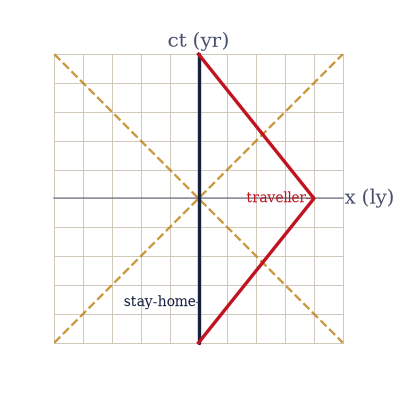
Fig. 360 The twin paradox on a spacetime diagram (centred on the turnaround). The stay-home twin follows the straight vertical worldline (dark); the travelling twin flies out at \(v=0.8c\) to \(x=4\,\)ly and back (red), a worldline bent at the turnaround. The bend is the whole point: only the traveller accelerates, so the situation is not symmetric. In the spacetime metric the bent path is shorter in proper time, so the traveller ages less.#
round trip at v = 0.8c, coordinate time T = 10.0 yr,  γ = 1.6667
stay-home twin ages  τ = 10.000 yr
travelling twin ages τ = 6.000 yr   (younger by 4.000 yr)
Validation 1#
✓  T/γ agrees with the worldline proper-time integral — the traveller ages less   [got 6 vs expected 6 (rtol=1e-09, atol=1e-09)]
✓  the travelling twin returns younger than the stay-home twin
True
Exercise 2 — The twin paradox, honestly: smooth acceleration (worked)#
The instant turnaround is a fiction — a real rocket accelerates smoothly — so let us do the honest computation and integrate the proper time along a smooth worldline. Take the speed profile \(\beta(t)=0.8\,|\sin(\pi t/T)|\), which starts and ends at rest and reverses direction at the midpoint turnaround Eq. 348. The proper time is then the integral \(\tau=\int_0^T\sqrt{1-\beta(t)^2}\,dt\), with no shortcut, and it depends only on the speed, not the direction. The point worth stressing is that the resolution of the paradox is not rhetoric: it is a number, obtained by integrating along the worldline — here about \(8.13\,\)yr against the stay-home twin’s \(10\,\)yr. The animation (Fig. 361) shows the two clocks ticking as the worldlines develop, the traveller’s visibly falling behind.
Part a) Define the speed profile as beta_profile(t), and integrate the proper time
along it two independent ways: with the proper_time you wrote in Exercise 1
(numpy.trapezoid over a dense grid) and with scipy.integrate.quad on the same
integrand.
Part b) Confirm that the two integrators agree and that \(\tau<T\): the accelerated twin ages less than the stay-home twin, smooth turnaround and all.
smooth profile β(t) = 0.8·|sin(πt/T)|, T = 10.0 yr
proper time τ  (np.trapezoid)          = 8.1255 yr
proper time τ  (scipy.integrate.quad)  = 8.1255 yr
stay-home twin ages T = 10.0 yr;  τ < T : True
Validation 2#
✓  the proper-time integral by np.trapezoid and scipy.integrate.quad agree   [got 8.1255 vs expected 8.1255 (rtol=0.001, atol=1e-09)]
✓  the accelerated twin's proper time is less than the stay-home twin's
True
Fig. 361 The twin paradox, developing in time (animated). As coordinate time advances, the stay-home worldline (dark) and the smoothly-accelerated traveller’s worldline (red) grow together, while the two clock readouts drift apart: the stay-home clock reads the coordinate time, the traveller’s reads the proper-time integral \(\int\sqrt{1-\beta(t)^2}\,dt\), which falls steadily behind. By reunion the traveller has aged \(\approx8.13\,\)yr against the stay-home twin’s \(10\,\)yr.#
Exercise 3 — Why the inertial worldline is longest (worked)#
Behind the twin paradox is the geometric heart of the whole subject. Between two fixed events, many worldlines are possible, and they do not all carry the same proper time. The inertial (straight, constant-velocity) worldline carries the most, and every bent detour carries less Eq. 348. This is the exact opposite of Euclidean geometry, where the straight line is the shortest distance between two points; the minus sign in the spacetime metric flips “shortest” to “longest” (Fig. 362). The family compared below is the out-and-back profile of Exercise 2 with its top speed dialled up: \(\beta(t)=\text{peak}\cdot|\sin(\pi t/T)|\), where \(\text{peak}=0\) is the straight inertial worldline of the twin who never moves at all. All of them start and end together.
Part a) Write bent_beta(peak), returning that speed profile for a given top speed,
and evaluate the proper time of five worldlines, \(\text{peak}=0,\,0.3,\,0.5,\,0.8,\,0.95\),
each with the proper_time you wrote in Exercise 1.
Part b) Confirm with a numpy comparison that the straight worldline carries the
maximum: its proper time is the largest of the five, and every bent one is strictly
shorter.
  peak β     proper time τ (yr)
   0.00        10.0000  ← inertial (straight)
   0.30        9.7711
   0.50        9.3422
   0.80        8.1255
   0.95        7.0201

the straight worldline is the longest: True
Validation 3#
✓ the inertial (straight) worldline maximizes proper time
True
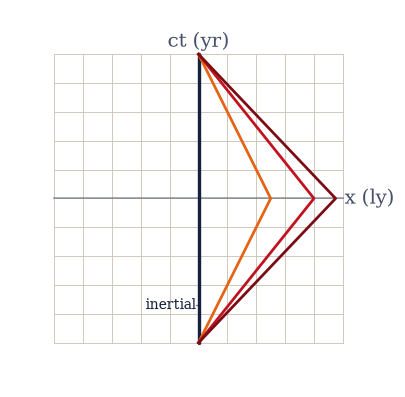
Fig. 362 Competing worldlines between the same two events. The straight inertial worldline (dark, \(\beta=0\)) and three bent ones reaching \(\beta=0.5,0.8,0.95\) (reds, lighter for faster) all start and end together, but the straight one accumulates the most proper time and the most sharply bent the least. In spacetime the straight path is the longest in proper time — the reverse of the Euclidean rule — which is exactly why the stay-home twin ages more.#
Exercise 4 — The pole-barn paradox, both frames (worked)#
Now the second classic. A pole of proper length \(L_p=10\,\)m is carried at \(v=0.8c\) toward a barn of proper length \(L_b=8\,\)m with doors at both ends. In the barn’s frame the pole is length-contracted to \(L_p/\gamma=6\,\)m, comfortably shorter than the \(8\,\)m barn, so for an instant it is fully inside and both doors can shut. But in the pole’s frame it is the barn that is contracted, to \(L_b/\gamma=4.8\,\)m, far too short to contain the \(10\,\)m pole Eq. 350. Both analyses are correct, which is exactly the apparent contradiction, and the next exercise resolves it.
Part a) Compute the contracted pole in the barn frame and the contracted barn in the
pole frame, each as the object’s proper length divided by gamma(0.8).
Part b) Confirm the two lengths are \(6\,\)m and \(4.8\,\)m: each frame sees the other object contracted, and neither sees its own.
proper lengths: pole 10.0 m, barn 8.0 m;  v = 0.8c,  γ = 1.6667
barn frame: pole contracts to 6.00 m  →  fits in the 8.0 m barn
pole frame: barn contracts to 4.80 m  →  the 10.0 m pole does NOT fit
Validation 4#
✓ each frame sees the OTHER object contracted (pole→6 m, barn→4.8 m) [max|Δ| = 8.88178e-16 (rtol=0.001, atol=1e-09)]
True
Exercise 5 — Pole-barn resolved by simultaneity (worked)#
The resolution is the relativity of simultaneity Eq. 347. “The pole is fully inside with both doors shut at the same time” is a claim about simultaneity, and simultaneity is frame-dependent. In the barn frame the two doors shut simultaneously, with the pole momentarily enclosed; but transforming those two events to the pole frame, they are separated by \(\Delta t'=\gamma vL_b/c^2\) Eq. 350. In the pole frame the far door shuts and reopens before the near door shuts, so the pole is never enclosed and never in danger (Fig. 363). Both frames agree on every physical fact — no door ever strikes the pole — and disagree only about the word “simultaneous”. In the barn frame the two door-closings are the events \((t{=}0,\ x{=}\mp L_b/2)\), one at each end of the \(8\,\)m barn, and the time part of the Lorentz transformation of §4.2 carries them to the pole frame as \(t'=\gamma(t-vx/c^2)\).
Part a) Transform both door-closing events to the pole frame with that map, and difference the two mapped times.
Part b) Confirm the offset equals the closed form \(\gamma vL_b/c^2\approx35.6\,\)ns: the events simultaneous in the barn frame are a definite \(35.6\,\)ns apart in the pole frame.
door-closings: simultaneous in the barn frame (Δt = 0)
in the pole frame they are Δt' = γ v L_b/c² = 35.6 ns apart
so the pole is never fully enclosed in its own frame — no contradiction
Validation 5#
✓ transforming the door events gives the simultaneity offset Δt'=γvL_b/c² [got 3.55802e-08 vs expected 3.55802e-08 (rtol=1e-09, atol=1e-09)]
True
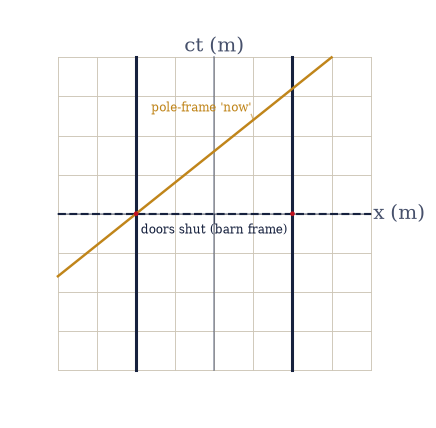
Fig. 363 The pole-barn paradox resolved (barn frame, \(x\) in metres, \(ct\) in metres). The two barn doors are vertical worldlines at \(x=\pm4\,\)m (dark); the two door-closing events (red) lie on the barn-frame line of simultaneity \(ct=0\) (dark dashed), so in the barn frame both shut at once with the pole inside. The pole frame’s line of simultaneity through the left event (amber, slope \(\beta\)) does not pass through the right event: in the pole frame the doors shut at different times, \(\gamma vL_b/c^2\) apart, and the pole is never enclosed.#
Exercise 6 — The relativistic Doppler effect (worked)#
The Doppler effect is not a paradox but a real, observable consequence, and relativity modifies the familiar classical version by folding in time dilation. A source approaching at \(\beta\) is blueshifted and one receding is redshifted, by \(f_{\rm obs}/f_{\rm src}= \sqrt{(1\pm\beta)/(1\mp\beta)}\) Eq. 351. The shift grows without bound as \(\beta\to 1\) — light from a source rushing toward us at near-\(c\) piles up enormously (Fig. 364). This is the effect behind the cosmological redshift, by which the recession of distant galaxies stretches their light toward the red.
The shift is worth deriving kinematically rather than quoting, and the kinematics is two-part bookkeeping. An approaching source emits ticks at proper intervals \(d\tau\); in our frame those emissions are \(\gamma\,d\tau\) apart, by time dilation, and between them the source closes \(v\gamma\,d\tau\) of the distance, so each pulse has a shorter journey than the one before it. Both effects land in the arrival times, and their spacing is what a receiver actually measures.
Part a) Simulate six pulses from a source at \(\beta=0.5\): place the emission times \(\gamma\,d\tau\) apart in our frame, move the source between them, add each pulse’s own light-travel time to reach the observer, and read \(f_{\rm obs}/f_{\rm src}\) off the mean arrival spacing. Repeat with the velocity reversed for recession. Write this one yourself — the implementation is the lesson: the shift has to fall out of the emission and arrival bookkeeping, not out of a formula copied down in advance.
Part b) Confirm the measured ratios equal \(\sqrt{(1+\beta)/(1-\beta)}=\sqrt3\approx1.73\) for approach and its reciprocal \(1/\sqrt3\approx0.58\) for recession.
β = 0.5:
approach (measured from pulse arrivals): f_obs/f_src = 1.7321   [√((1+β)/(1−β)) = 1.7321]
recession (measured):                    f_obs/f_src = 0.5774   [√((1−β)/(1+β)) = 0.5774]
Validation 6#
✓  the pulse-arrival simulation reproduces the approach shift √((1+β)/(1−β))   [got 1.73205 vs expected 1.73205 (rtol=1e-09, atol=1e-09)]
✓  and the recession shift √((1−β)/(1+β)) — Doppler derived, not quoted   [got 0.57735 vs expected 0.57735 (rtol=1e-09, atol=1e-09)]
True
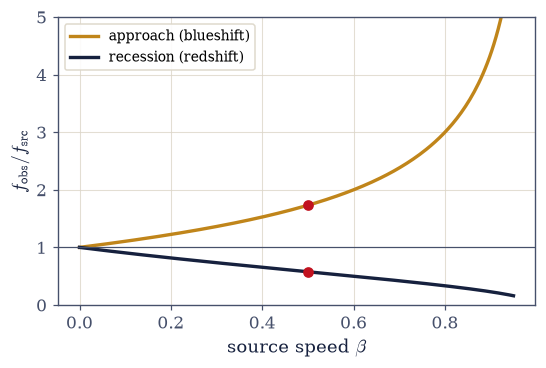
Fig. 364 The relativistic Doppler shift \(f_{\rm obs}/f_{\rm src}=\sqrt{(1\pm\beta)/(1\mp\beta)}\) against speed. A source approaching (amber) is blueshifted, the ratio rising without bound as \(\beta\to1\); a receding source (dark) is redshifted toward zero. The two branches are reciprocals, meeting at \(1\) for a source at rest. At \(\beta=0.5\) the shifts are \(\sqrt3\approx1.73\) and \(1/\sqrt3\approx0.58\) (dots).#
Exercise 7 — The transverse Doppler effect (student)#
Here is the cleanest signature of time dilation in all of optics. Classically, a source moving across the line of sight — at the instant it is exactly abeam, \(90^\circ\) — produces no Doppler shift, because it is neither approaching nor receding. Relativistically, there is still a shift: a pure redshift by \(1/\gamma\), coming from time dilation alone, with no classical analog whatsoever Eq. 351. The moving source’s clock simply runs slow, so every frequency it emits arrives lowered. This transverse Doppler shift, measured by Ives and Stilwell in 1938, is a direct experimental confirmation of time dilation.
At \(90°\) there is no radial motion, so the shift is time dilation and nothing else: over one unit of our coordinate time the moving source’s clock advances by the proper-time integral \(\int_0^1\sqrt{1-\beta^2}\,dt\), and that ratio of clock rates is the ratio of frequencies. It is the same worldline integral as the twin computation, evaluated on a constant-speed profile.
Part a) Evaluate it at \(\beta=0.5\) over one unit of coordinate time, with the
proper_time you wrote in Exercise 1.
Part b) Confirm it equals \(1/\gamma\approx0.866\), and note what that means: a redshift (\(<1\)) at the one angle where the classical effect vanishes altogether.
β = 0.5, viewed transversely (90°):
classical Doppler shift = 1.000 (no approach or recession)
relativistic transverse shift = ∫√(1−β²)dt = 0.8660   [1/γ = 0.8660]  (a pure redshift)
a frequency shift with no classical analog — time dilation, seen directly
Validation 7#
✓ the proper-time integral gives the transverse shift 1/γ — pure time dilation [got 0.866025 vs expected 0.866025 (rtol=1e-09, atol=1e-09)]
True
Exercise 8 — No paradoxes, only careful bookkeeping#
Step back over the three puzzles. The twin “paradox” was a failure to notice that the worldlines are not symmetric, repaired by integrating proper time along each. The pole-barn “paradox” was a failure to notice that “simultaneously” means different things in different frames, repaired by transforming the two door events. The Doppler effect was never a paradox at all, just a consequence we had not yet computed. In every case the appearance of contradiction came from applying part of relativity while forgetting the rest. Special relativity is strange, but it is entirely self-consistent: the universe keeps no contradictory books, and we need only read them in the right frame.
The closing check is a single ordering. A clock that spends less of the trip at top speed is dilated less, so the smoothly-accelerated traveller of Exercise 2 should age more than the idealized instant-turnaround traveller of Exercise 1, and still less than the twin who never left.
Part a) Bring the three proper times together: the idealized \(T/\gamma\) of Exercise 1, the smooth-profile integral of Exercise 2, and the stay-home \(T\).
Part b) Confirm the chained comparison \(\tau_{\rm ideal}<\tau_{\rm smooth}<T\) holds — a quantitative, frame-independent statement with no trace of paradox in it.
idealized (instant turnaround) τ = 6.000 yr
smooth acceleration           τ = 8.125 yr
stay-home                     τ = 10.000 yr
ordering  τ_ideal < τ_smooth < T  holds: True
no paradox anywhere — only proper-time integrals and the relativity of simultaneity
Validation 8#
✓ the smooth-acceleration proper time sits between the idealized value and the stay-home time
True
Notebook summary#
The twin paradox Eq. 349, Eq. 348: the worldlines are asymmetric (only the traveller accelerates). Idealized, the traveller ages \(T/\gamma=6\,\)yr against \(10\,\)yr; with a smooth profile \(\beta(t)=0.8|\sin(\pi t/T)|\) the proper-time integral is \(\approx8.13\,\)yr by both
np.trapezoidandscipy.integrate.quad, still less than \(T\).The inertial worldline is longest Eq. 348: among paths between the same two events the straight one carries the maximum proper time, the reverse of the Euclidean rule — the geometric root of the twin result.
The pole-barn paradox Eq. 350: each frame sees the other contracted (pole \(\to6\,\)m in the barn frame, barn \(\to4.8\,\)m in the pole frame). It dissolves by simultaneity Eq. 347: the door-closings simultaneous in the barn frame are \(\Delta t'=\gamma vL_b/c^2\approx35.6\,\)ns apart in the pole frame, so “fully enclosed” is frame-dependent and nothing physical is contradicted.
The relativistic Doppler effect Eq. 351: \(\sqrt{(1\pm\beta)/(1\mp\beta)}\) gives blueshift \(\sqrt3\) and redshift \(1/\sqrt3\) at \(\beta=0.5\); the transverse shift \(1/\gamma \approx0.866\) is a pure redshift from time dilation, with no classical analog (Ives–Stilwell).
The lesson: every “paradox” was a bookkeeping slip — integrate proper time along the actual worldline, and remember that simultaneity is relative.
Outlook#
Relativistic dynamics (§4.5). Four-momentum, \(E=mc^2\), and relativistic collisions, where the kinematics of §4.1–§4.4 gains a dynamics.
The experimental record. Muon lifetimes (time dilation), Ives–Stilwell (the transverse Doppler computed here), and GPS clock corrections — a pointer to the SR+GR combination.
Accelerated observers in depth (§4.8). The turnaround twin generalises to the equivalence principle and the bridge to general relativity.
Cross-reference §4.1 (simultaneity), §4.2 (the transformation), and §4.3 (proper time and the spacetime-diagram primitive used throughout this notebook).